
Custom Passive House Builder in Point Pleasant, NJ
Gambrick Construction is a custom Passive House builder based right here in Point Pleasant with over 40 years of experience. We build high-performance homes across Ocean County & Monmouth County that use up to 90% less heating and cooling energy than a standard new build.
We don’t rely on expensive HVAC systems to keep you comfortable. Instead, we stop the air leaks by building an airtight building envelope that eliminates thermal bridging so the outside weather never reaches your interior spaces. We use extremely thick insulation, heavy triple-pane windows, and an Energy Recovery Ventilator (ERV) to constantly cycle fresh, filtered air into the house.
This advanced green building approach can save over 90% on heating and cooling costs and reduce water consumption by 50%. Whether you want a modern waterfront design or a traditional coastal home, we build it to the highest energy standard in the world.
Why Build a Green Home at the Jersey Shore?
Most houses built on the coast are basically wind tunnels. When a winter Nor’easter hits the barrier islands, standard fiberglass insulation fails and freezing air pushes right through the walls. In July, the thick humidity off the Barnegat Bay forces your HVAC system to run non-stop.
That’s why green home building is changing the local market. A true energy efficient house is built to fight the weather, not just survive it. We use sustainable, heavy-duty materials like Andersen or Marvin triple-pane windows, James Hardie fiber cement siding, and mineral wool (rockwool) insulation. These materials hold up against the harsh New Jersey climate and stop moisture before it gets inside the walls.
Upgrading to a certified Phius (Passive House Institute US) standard gives you the highest level of performance possible. You get superior indoor air quality because we use low-VOC materials and a high-efficiency MERV 16 media air cleaner or a HEPA filtration system. These tie directly into the mandatory Heat Recovery Ventilator (HRV) or your ERV. This system cleans the air and physically stops mold and mildew from growing.
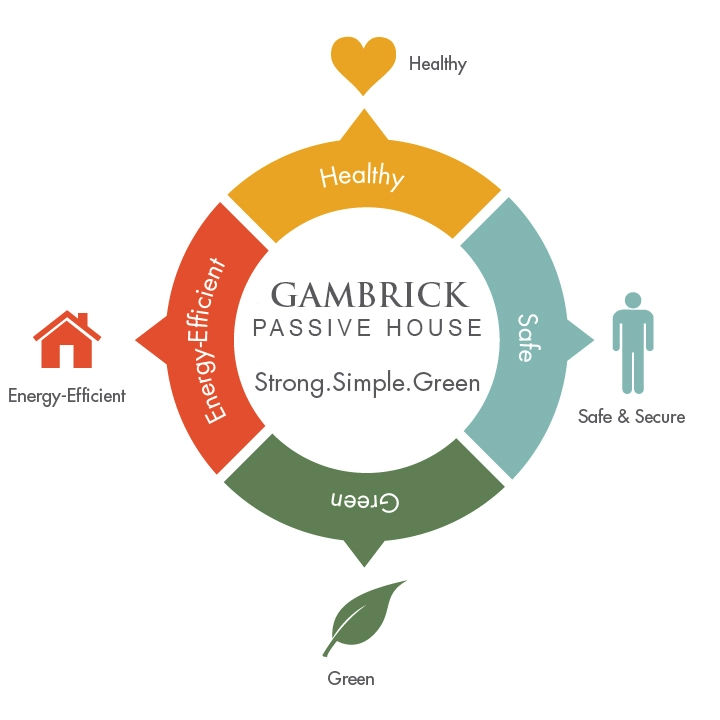
A true green build creates a healthier house, lowers your energy bills by up to 30%, and can cut your water usage in half.
How We Build Phius Certified Passive Houses
Building a certified passive home is an exact science where you cannot guess. We follow strict physics and building science principles established by the Passive House Institute (PHI) in Germany. To hit the certification, every house we build must pass these five core steps.
1. Continuous Super-Insulation
Standard 2×6 walls leave wood studs exposed to the cold. This creates a thermal bridge. The bridge pulls heat out of the house and lets the freezing cold in because energy passes right through the uninsulated studs.
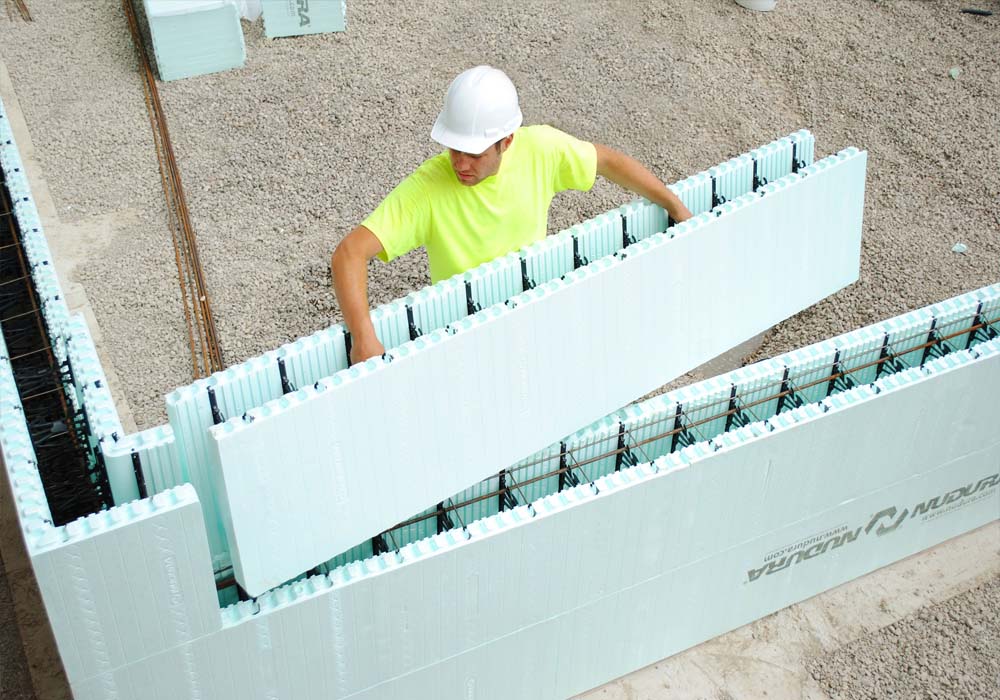
To fix this problem, we wrap the entire exterior of the house in continuous insulation. We use thick rigid foam or Zip System R-Sheathing combined with mineral wool or double stud walls and Insulated Concrete Forms (ICF). ICF blocks give you a solid reinforced concrete wall wrapped inside and out with thick foam.
Our combined approach helps us hit a massive R-value between R-40 and R-60. By creating a thick blanket around the frame the inside stays warm in the winter and cool in the summer.
When you combine super-insulation with an airtight frame, it can drop your heating and cooling demand by over 90% compared to standard construction.
2. An Airtight Building Envelope
Most coastal homes leak air like a sieve. We fix this by building a continuous, unbroken barrier around the entire building shell. This includes the walls, roof, and the foundation. It physically stops uncontrolled air leaks, drafts, and moisture from getting inside.
We seal every single gap, joint, and seam in the framing using an arsenal of high-performance materials. We wrap the house in smart membranes like the Intello Plus vapor retarder or self-adhering Proclima Solitex Adhero 3000. For the rigid air barrier, we use airtight OSB or plywood panels. We lock down every joint between the wood, concrete, and membranes with premium European tapes like SIGA, Proclima, or Coroplast RPX. If we hit complex framing junctions or difficult corners, we use liquid-applied coatings like Blowerproof paint to spray the gaps shut completely.
We even install specialized aluminum or timber windows with heavy-duty gaskets and taped seals. Before we put up a single sheet of drywall, we run a blower door test. The house has to hit strict air changes per hour (ACH) limits to pass the final inspection.
3. Eliminating Thermal Bridges
A thermal bridge is a fast lane for cold air to enter your house. A concrete balcony or a steel beam touching the outside air pulls the freezing cold right into your living room. We eliminate these paths. We use a structural thermal break like a Schöck Isokorb block to physically detach the exterior elements from the interior frame. This stops cold spots and prevents black mold from forming inside the walls.
4. High-Performance Triple-Pane Windows
Windows are usually the biggest holes in your insulation. Standard double-hung windows leak air and let the sun bake your living room. We install heavy, European-style tilt-and-turn windows. They have three layers of glass filled with argon gas or krypton gas. We calculate the exact U-factor and Solar Heat Gain Coefficient (SHGC) for every single unit. The winter sun helps heat the house, but the harsh summer sun gets blocked completely.
5. Fresh Air with ERV Systems
Because the house is completely airtight, it needs to breathe. We install a constant mechanical ventilation system using a premium Zehnder unit. It pulls stale air and heavy moisture out of the bathrooms and kitchen and pushes filtered, fresh air directly into the bedrooms and living spaces.
The ERV captures latent heat from the exhaust air and transfers it to the fresh air coming in. You get constant fresh air without opening a window and losing your expensive AC.
What Does an Energy Efficient Passive House Cost To Build?
Building a custom home at the Jersey Shore is a big investment. Upgrading to a certified Passive House usually adds a 7% to 15% premium to your upfront construction costs. A custom, high-performance build typically runs between $300 and $500+ per square foot.
That extra money goes directly into the bones of the house. You’re paying for thicker framing and insulation, heavy triple-pane windows, specialized tapes and membranes, and the mechanical ventilation system. You also have to factor in the specialized design and energy modeling required to pass the strict certification.
Keep in mind, “passive” just refers to the building envelope. Your final price still depends heavily on the luxury finishes you choose, the size and design of the home, and the complexity of your coastal lot.
The NJ Board of Public Utilities offers financial incentives for projects that hit Phius standards. When you combine those local rebates with the fact that a Passive House can slash your monthly utility bills by over 90%, the return on investment happens fast.
Frequently Asked Questions About Passive Homes
Here are the straight answers to the most common questions we get from homeowners looking to build a green home in New Jersey.
Can you build a Passive House right on the water at the Shore?
Yes. It is actually the best place to build one. Waterfront lots take a beating from heavy salt spray and hurricane-force winds. The airtight envelope and continuous insulation protect the frame from rotting and stop the coastal wind from drafting into your living room.
How long does it take to build a Passive House?
It takes about 12 to 14 months. The actual construction timeline is basically the same as building any high-end custom home. The real delay is usually waiting on local town approvals or CAFRA permits if you are building right on the water. We walk you through the real schedule before we dig a hole.
Do Passive Houses actually work in New Jersey’s extreme seasons?
Absolutely. The building science is designed specifically to handle freezing January storms and 100-degree August humidity. Because the house is completely sealed, you do not have to rely on a massive furnace or AC unit to fight the weather outside. The inside stays comfortable all year long.
Do I have to get the official Phius certification?
No. Official certification is optional. We can build your house to the exact same strict performance standards without paying for the official testing and paperwork. Getting certified proves the home’s performance and adds massive resale value, but it does add to your upfront cost. It is your house, so it is your choice.
Can I still open the windows in an airtight house?
Yes. A lot of people think an airtight house means the windows are bolted shut. You can open the heavy triple-pane windows whenever you want to let the ocean breeze in. When you lock them back up, the ERV system goes right back to cycling fresh, filtered air through the rooms.
Can I build a Passive House with ICF?
Yes. ICF is actually one of the best ways to build a green home on the coast. Because the blocks are made of solid concrete sandwiched between thick foam, they give you an airtight, super-insulated wall in one step. It easily hits strict Phius standards. On top of the energy savings, an ICF house can withstand hurricane-force winds and flying debris during a severe coastal storm.
What Local Homeowners Say About Our Builds
You don’t have to take our word for it. Here’s what homeowners across the state say about living in a high-performance Gambrick home.
★★★★★ “Gambrick built our dream house in Passaic County, and we could not be happier. The home is incredibly quiet, comfortable in every season, and our energy bills have dropped dramatically. The team was professional, knowledgeable, and always available to answer our questions.” — Melissa G., Hewitt.
★★★★★ “From the design phase to the final walk-through, the process was smooth and well-managed. John’s experience in sustainable construction really shows. We loved working with a local builder who understands what it takes to build a truly energy-efficient home.” — Daniel & Kate M., Point Pleasant.
★★★★★ “We were new to building, but the Gambrick team took the time to explain everything. The quality of the build is outstanding, and the indoor air quality is noticeably better than our old home. Highly recommend them to anyone looking to build a smarter, greener home.” — James R., Freehold.
★★★★★ “What really impressed us was the attention to detail. Every part of the home was carefully thought out, and it performs exactly as promised. It is clear that Gambrick takes pride in their work, and we are grateful to have found such a reliable local builder.” — Samantha T., Spring Lake.
Passive House Service Areas
Gambrick Construction is based in Point Pleasant, NJ. Our core service area covers the coastal communities of Ocean and Monmouth County. We build high-performance homes designed to fight the local weather.
- Point Pleasant Beach & Borough: home base, on-site daily for airtight framing and continuous insulation projects.
- Bay Head & Mantoloking: barrier island passive builds, blocking extreme salt air and high winds right on the ocean.
- Manasquan & Brielle: Manasquan River waterfront green homes and ICF construction.
- Spring Lake & Sea Girt: luxury passive homes and high-end energy-efficient coastal builds.
- Brick Township & Toms River: high-performance knockdown rebuilds to stop heavy humidity off the Barnegat Bay.
- Lavallette & Ortley Beach: barrier island green builds engineered to survive severe coastal winter storms.
- Wall Township & Howell: custom high-performance homes and heavily insulated inland builds.
- Rumson & Colts Neck: luxury energy-efficient estates in Monmouth County.
- Princeton: select large-scale certified passive home projects.
Statewide: We accept select large-scale Phius and energy-efficient custom home projects throughout New Jersey, including Bergen, Essex, and Mercer Counties, on a case-by-case basis.
Ready to talk about your project? Call 732-892-1386 or contact us online. We offer free consultations. We give you a straight answer on what your lot can support for a true green build before you spend a dime on architectural design work.