
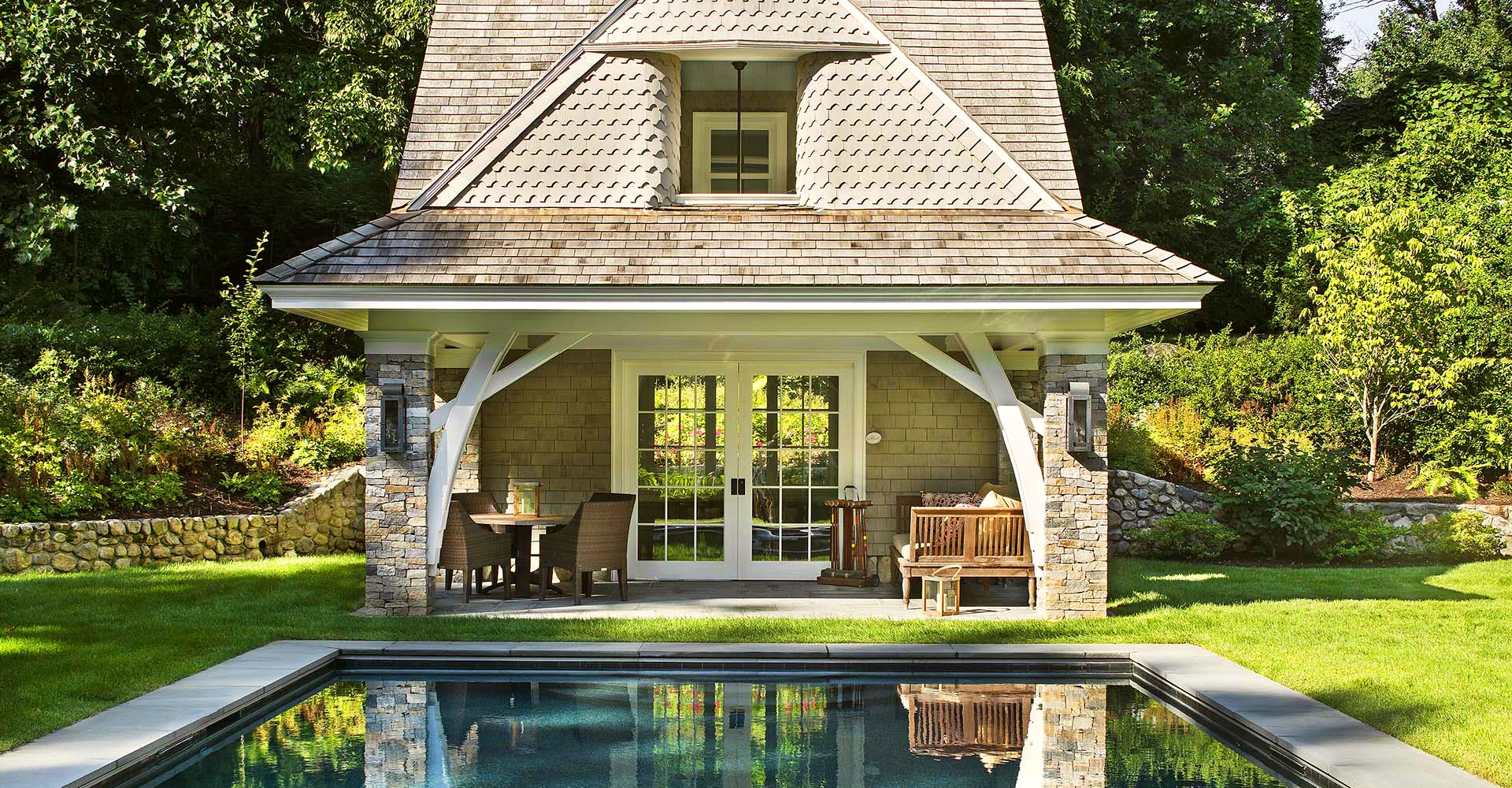
ADU Builder & Accessory Building Construction in NJ
Licensed in New Jersey: NJ HIC #13VH10907000 | NJ New Home Builder Reg #51766 | Fully bonded and insured | 40+ years on the Jersey Shore
Gambrick Construction designs and builds fully custom accessory dwelling units (ADUs) and accessory buildings throughout New Jersey, with concentrated work in Ocean and Monmouth County. We build detached ADUs, attached ADUs, garage conversions, in-law suites, pool houses, detached garages, and backyard studios. We don’t drop generic prefab boxes into your yard, we engineer custom structures to match your home’s architecture, fit your specific zoning envelope, and meet your exact needs.
Building accessory structures in NJ comes with two layers of regulation: every town writes its own ADU rules under New Jersey’s home-rule zoning structure, and Shore lots add coastal flood and CAFRA requirements on top. Lot coverage rules are strict, adding a 600-square-foot ADU can easily push your property over its impervious surface limit. Coastal lots in FEMA V-Zones and A-Zones often require deep-driven helical piles or treated timber pilings. Because NJDEP CAFRA jurisdiction covers most barrier islands and coastal towns, we handle the lot coverage math, flood zone analysis, foundation engineering, and the full local and state permitting process for you.
Custom Accessory Buildings: ADUs, Pool Houses & Carriage Houses
An accessory building is any permanent structure on your property that isn’t your main house. We do not use prefab kits. We engineer custom structures to clear local zoning codes and meet your long-term needs.
- Custom Pool Houses & Cabanas: Fully integrated with electrical, plumbing, and HVAC. We use storm-ready James Hardie fiber cement, AZEK trim, and impact-resistant Andersen or Marvin windows.
Zoning Note: Full kitchens often trigger strict “dwelling unit” zoning. We design pool houses with wet bars to avoid this unless your town specifically permits a full ADU. - Carriage Houses: The most cost-effective way to double square footage on coastal lots in Manasquan and Sea Girt. Keep your parking below while adding a finished room or full ADU above a detached garage.
- Backyard ADUs & Cottages: Popular in Bay Head and Mantoloking. We match your primary home’s cedar shakes and roof pitch. Where zoning allows, these independent dwellings feature full kitchens, bedrooms, and bathrooms for family or rental income.
- In-Law Suites: Designed with a separate entrance, bedroom, bathroom, and kitchenette. We specialize in aging-in-place design, integrating wider doorways and zero-threshold showers.
- Year-Round Studios: Permanent backyard offices built with traditional framing, heavy insulation, and ductless mini-split heat pumps. Hardwired for internet and climate-controlled year-round.
- Custom Detached Garages: Matched to your property’s architecture with electrical roughed-in to support current parking and future conversions.
Zoning, Setbacks, and Permitting for NJ ADUs
Because New Jersey is a “home rule” state, every municipality writes its own ADU rules. You need a builder who knows the local code. With 40+ years on the Jersey Shore, we know how rules change from block to block. In Point Pleasant Beach alone, zoning shifts drastically between Main Street, the Boardwalk, the Library Section, and the Lakes.
Most towns enforce strict ADU-specific requirements:
- Size Limits: Most NJ towns cap detached ADUs between 800 and 1,200 sq. ft., depending on the zoning district.
- Owner Occupancy: Many municipalities require the property owner to live in either the main house or the ADU to prevent double-rental investment properties.
- Parking Minimums: Towns often require dedicated off-street parking for an ADU. We verify your lot’s requirements before design begins.
- Design & Historic Review: Zoning boards often require the ADU to match the primary home’s siding and roof pitch. Historic districts mandate highly specific material approvals.
- Impervious Surface Limits: This is the number one reason ADU projects get denied. Every NJ town caps how much concrete, asphalt, and roofline can cover a lot. If you are near the limit, we can often replace existing concrete with permeable pavers to make the math work.
- Fire Codes & Setbacks: Fire codes mandate 5- to 10-foot setbacks from property lines. We survey property lines first so the ADU is sited correctly.
- Variances & CAFRA Permits: If a design breaks a zoning rule, we handle the formal variance application and zoning board hearings. For coastal lots, we file the NJDEP CAFRA permit simultaneously to keep your project moving.
How We Build NJ ADUs & Accessory Structures
Building an ADU is faster than primary residential construction but demands highly specific engineering, especially when matching existing architecture.
Here is our process from approved permits to your final Certificate of Occupancy (CO).
- Site Prep & Foundations: Foundation types depend on flood zones and soil capacity. Inland projects use code-rated concrete spread footings. For lots in FEMA V-Zones or coastal A-Zones, we install deep-driven helical pilings or treated timber to lift structures above Base Flood Elevation. We coordinate any required septic upgrades with the County Health Department before breaking ground.
- Framing & Structural Engineering: We use 2×6 framing packed with closed-cell spray foam or Rockwool insulation. Coastal engineering is calibrated to Exposure D wind loads, the NJ building code’s most severe category. We secure the continuous load path using Simpson Strong-Tie hardware and Type 316 marine-grade stainless steel fasteners.
- Architectural Exterior Matching: We match your main property’s architecture using real cedar shake, James Hardie fiber cement, or AZEK PVC trim. We install impact-rated Andersen or Marvin windows, topped with architectural shingles or standing-seam metal roofing rated for sustained coastal winds.
- Independent Utilities (MEP): We install dedicated electrical service, including separate meters for rental units. We use ductless mini-split heat pumps for year-round climate control and tie water and waste lines directly into your main house or municipal street connections.
- Interior Finish & Final Inspection: Interiors receive our premium finish grade, including Level 5 smooth drywall, custom trim, and luxury fixtures. We manage every local building department inspection. We hand over the keys only after the town issues the formal Certificate of Occupancy (CO), ensuring the structure is legally approved.
ADU & Accessory Building FAQ
How much does it cost to build an ADU in NJ?
Custom ADUs in NJ range from $100,000 to over $300,000. The price depends on the size, foundation type, and finish level. A 600-to-800 square foot detached ADU on an inland concrete spread footing with mid-range finishes typically costs $120,000 to $250,000. The exact same unit built in a coastal FEMA V-Zone requiring helical pilings, marine-grade exteriors, and custom millwork will run $200,000 to $300,000+. We provide exact line-item pricing after the design phase.
How long does it take to build an ADU?
Most ADU projects take 10 to 16 months from a signed contract to your Certificate of Occupancy. Design and engineering take 2 to 4 months. Permitting takes another 2 to 4 months, though it takes longer if you need zoning variances or NJDEP CAFRA approvals. Construction takes 6 to 8 months. Simple pool houses finish faster, while full ADUs with kitchens and independent utilities take longer.
Can I build an ADU if my town previously banned them?
It depends on the town. New Jersey is a “home rule” state, meaning local municipalities control their own zoning. While lawmakers have pushed for a statewide ADU allowance, there is currently no blanket law overriding local bans. However, recent 2024 state affordable housing mandates heavily incentivize towns to legalize ADUs. Coastal towns like Asbury Park and Bradley Beach are already updating their codes. We check your specific municipal zoning to determine exactly what is allowed on your lot.
Do I have to live on the property?
Usually, yes. Many municipalities enforce strict owner-occupancy requirements to prevent investors from turning single-family lots into double-rental properties. The general rule is that you must live in the main house to rent the ADU, or live in the ADU to rent the main house. Because there is no statewide standard, we verify your local town’s occupancy rules before beginning any design work.
Can I use my backyard cottage for a short-term rental?
Maybe, but you must check the local municipal ordinance. Many Jersey Shore towns heavily regulate short-term rentals, requiring minimum lease terms of 30, 60, or 90 days. These local rules apply equally to ADUs and primary homes. We verify the exact rental duration limits and occupancy taxes in your town before designing the unit.
Can I build an ADU on an oceanfront lot or near sand dunes?
Sand dunes are fiercely protected by the NJDEP under CAFRA jurisdiction. You generally cannot excavate or alter dune sand levels. Building is possible on oceanfront lots if you meet proper setbacks and use V-Zone foundations like helical pilings or treated timber pilings. However, the structure’s placement is tightly constrained by both local setback rules and strict state dune protection requirements.
Does a detached garage count against my lot coverage?
Yes. In towns like Point Pleasant Beach and Manasquan, any impervious surface counts toward your limit. This includes the garage footprint, the driveway, and concrete pads. Some towns even count large roof overhangs. We run the exact lot coverage math before design begins to ensure your project will not exceed the legal limit.
Do I need a foundation for a shed or studio?
If the structure is finished with electrical, plumbing, or HVAC, like a year-round studio or detached gym, it requires a permanent foundation. Inland sites use code-rated concrete footings. Flood zone projects require deep-driven pilings. A simple, uninsulated storage shed without utilities can often sit on a gravel pad or pre-cast concrete blocks, depending on local codes.
What’s the difference between an ADU and a regular accessory building?
The legal difference usually comes down to the kitchen. Under most NJ zoning codes, an “accessory building” is any permanent structure that isn’t the main house, such as a pool house, detached garage, or studio. An Accessory Dwelling Unit (ADU) is a structure with full residential capability: a bedroom, full bathroom, independent utilities, and a kitchen. Because an ADU is a fully independent home, it is subject to much stricter zoning, parking, and rental regulations than a standard pool house.
NJ ADU & Accessory Building Service Areas
Gambrick Construction is based in Point Pleasant, NJ. Our core service area covers the coastal communities of Ocean County and Monmouth County, with select inland projects across the state. As municipalities update their zoning to meet new affordable housing mandates, ADU demand is growing rapidly. We serve both established Shore markets and expanding inland areas.
Coastal Shore Markets:
- Point Pleasant Beach & Borough: Our home base. ADU projects on tight coastal lots, navigating strict impervious coverage limits and CAFRA permits.
- Bay Head & Mantoloking: Detached guest cottages on barrier-island lots, designed to match local cedar-shake architecture. We use V-Zone foundations on helical pilings.
- Manasquan & Brielle: Carriage houses above detached garages, rental ADUs along the Manasquan River, and waterfront pool houses.
- Spring Lake & Sea Girt: High-end pool houses, in-law suites, and detached guest cottages integrated into estate-scale renovations.
- Brick Township & Toms River: Detached ADUs and garage conversions on larger lots as local zoning rules evolve.
- Lavallette & Ortley Beach: Pool houses and accessory buildings engineered for Exposure D wind loads and harsh salt-air exposure.
- Rumson, Fair Haven & Colts Neck: Detached guest cottages, year-round backyard studios, and pool houses on larger estates. Strong demand for aging-in-place in-law suites.
Inland & Statewide Markets:
- Wall Township, Howell & Freehold: Detached ADUs and standalone garages with finished space above. Larger lots support full ADUs without triggering lot coverage issues.
- Princeton, West Windsor & Pennington: ADUs for multi-generational households, backyard offices, and detached studios.
- Bergen County (Saddle River, Franklin Lakes, Alpine): Estate-scale ADUs and pool houses matching high-end primary architecture.
- Essex, Somerset & Morris County (Short Hills, Summit, Far Hills): Multi-generational ADUs, in-law suites, and backyard studios in affluent inland markets.
We’re a fully licensed and insured general contractor operating statewide. For projects outside these primary service areas, contact us to discuss site feasibility.
Build Your ADU with Gambrick
A custom ADU project starts with a feasibility conversation, not a sales pitch. We will walk your lot, review your survey, calculate your impervious coverage constraints, and tell you honestly what your property can support under local zoning. We’ll discuss architectural design, foundation requirements, utility connections, and realistic permit timelines.
There is no fee for the consultation and no obligation to move forward. If you already have inspiration photos or a rough design idea, bring them. If you’re starting from a blank lot, we will start with the lot assessment and survey review.
Call(732) 892-1386 or contact us online to schedule your consultation.