
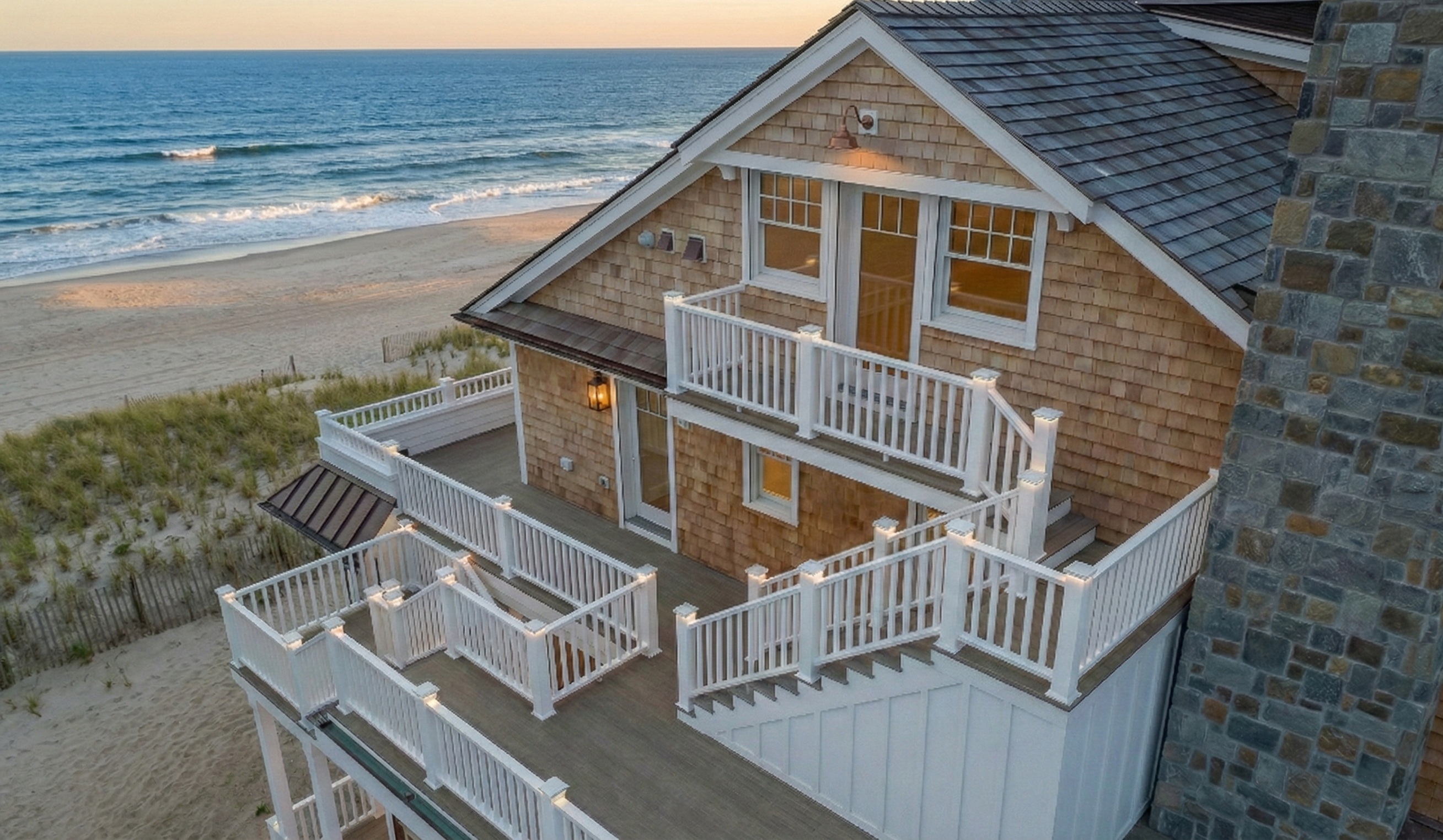
Custom Multi-Level Deck Builder in Point Pleasant, NJ
As a local multi-level deck builder, Gambrick Construction has spent over 30 years building custom outdoor living spaces at the Jersey Shore.
If your home in Point Pleasant or Bay Head is raised on pilings to meet FEMA flood codes, a standard 12×12 flat deck simply doesn’t work. When your main floor is 10 to 15 feet in the air, you need a safe way to get down to the yard, and you need a smart layout so you aren’t walking up and down a massive flight of stairs.
We frame multi-tier bespoke composite & wood decks that solve this problem. We build a top tier for grilling right off the kitchen, a lower tier for lounging, and wide, comfortable stairs to connect them. Because these structures sit so high off the ground, we anchor them deep into the sandy soil using Helical Piles and heavy-duty Simpson stainless steel hardware. This stops the deck from swaying when the coastal winds blow off the Manasquan River.
The Reality of Decks for Raised Coastal Homes
When you lift a house in Ocean & Monmouth County to comply with new FEMA flood maps, the biggest aesthetic problem is the giant, ugly wooden pilings holding the house up. If you slap a wooden deck against the side of a lifted house, it can look tacked on and cheap.
A multi-level deck fixes the “house on stilts” problem. We design the deck to act as an architectural bridge between your elevated first floor and the ground.
- Hiding the Pilings: Lower tiers of the deck can be dropped down to cover the exposed foundation. We wrap the base in custom skirt boards or louvered vinyl panels that match your siding. This makes the deck look like a natural extension of the house instead of an afterthought.
- Breaking Up the Height: A sheer drop off the back of a house is an eyesore and a safety concern. Stepping the deck down in two or three distinct levels softens the elevation. It tricks the eye and grounds the house back into the yard.
- Under-Deck Inspections: A raised house means the deck frame is exposed underneath. Hidden rot in support posts and failing ledger boards are the primary causes of failure in older decks. Being able to easily inspect the framing from below allows us to spot early signs of water damage before the structure becomes unsafe.
- Usable Space Underneath: The higher the deck, the more usable space you have underneath. Pouring a concrete pad and framing the underside creates a shaded outdoor living space, a massive storage area for surfboards and bikes, or a dry carport.
Designing Multi-Level Decks (Tiers, Stairs, & Flow)
Many shore homes are elevated due to flooding concerns after Hurricane Sandy. When your living area sits 10 to 15 feet high, getting to the yard safely takes planning. A smart multi-level design turns a tricky coastal lot into an organized, functional outdoor space.
- Upper Tier (Views & Airflow): Connecting directly to your main floor, this level maximizes panoramic water views and catches the breeze during hot Jersey summers. It is the perfect spot for morning coffee or sunbathing.
- Lower Tiers (Dining & Zoning): Dropping down a few feet creates a dedicated zone for heavy lounge furniture. This separation ensures patio chairs don’t block your view from inside the house.
- High Occupancy (Rental Homes): Summer rentals host large groups. We frame these decks to handle heavy foot traffic so the structure never feels “bouncy” or unstable when packed with guests.
- Custom Extras: Multi-level layouts easily accommodate heavy additions. We can reinforce the frame for a recessed hot tub, a built-in outdoor kitchen, or a custom cedar pergola.
- The Stairs: A straight 20-step flight is exhausting. We build wide switchback stairs with flat landings to break up the climb, making the transition from a stilt-house to the pool much safer.
- Materials: Premium composite decking like Azek and Trex, or hardwoods like Ipe, are the best choices for the coast. They resist rot and salt spray far better than traditional pressure-treated wood.
- The Payoff: A tiered deck adds architectural dimension to a lifted house. In our local market, this construction typically brings a 65% to 80% Return on Investment (ROI).
Engineering for Sandy Soil & High Coastal Winds
Framing a second-story structure requires serious engineering. A tragic collapse in Wildwood, NJ recently showed exactly what happens when tall coastal structures use outdated materials. Due to the massive height and heavy safety railings, a multi-level deck typically costs 50% to 100% more than a ground-level patio.
- Footings in the Sand: You cannot just pour concrete into beach sand. We drive Helical Piles deep into the earth. These giant steel screws bite into solid ground so shifting coastal sand never erodes the base of your posts.
- Wind Loads: A tall deck acts like a giant sail. To fight off lateral forces during a heavy Nor’easter, we install custom Y-bracing and V-bracing so the frame stays completely rigid. Bouncy or swaying decks need an immediate professional inspection.
- Stopping “Pancake” Collapses: Tiered layouts create complex load paths. If an overloaded upper tier fails, it crashes down, causing a catastrophic progressive failure or “pancake” collapse. Our engineers calculate exact beam sizing to handle heavy crowds safely.
- Saltwater Corrosion: Humid salt air rapidly rusts cheap joist hangers. Once that hardware experiences metal fatigue, the frame becomes unsafe. We use corrosion-resistant stainless steel and apply butyl joist tape over the framing to stop hidden rot.
- Safety Railings: We build rock-solid, code-compliant railings 36 to 42 inches high to prevent dangerous falls.
- State Flood Rules: The NJ DEP often requires homes to sit 5 feet higher than the FEMA base flood elevation. This changes how we connect the ledger board and means navigating strict CAFRA limits, which adds time to the permit process.
What Local Homeowners Are Saying About Gambrick
★★★★★ “Handled the town permits and built a rock-solid frame.” “Building a deck on a raised FEMA-compliant house in Point Pleasant is a nightmare with the town zoning. Gambrick handled all the annoying paperwork and built us a heavy natural cedar deck with custom timber stairs. It does not shake at all when the wind blows off the water. Honest builders who actually show up.” — Mike T., Point Pleasant, NJ
★★★★★ “They handled everything, even the permits.” “We live in Brick Township, and I was dreading the whole permit process. Gambrick took care of it all and made the experience stress-free. Our new multi-level Trex deck turned out even better than we imagined. The craftsmanship is excellent, and they finished on schedule.” — James T., Brick, NJ
★★★★★ “Clean demolition and zero rust.” “Our old deck was literally rotting off the back of our house in Mantoloking. Gambrick tore it down without ruining our landscaping. They fixed the rotted ledger board on the house and used 316 marine-grade stainless steel hardware for the new frame. The crew worked hard and cleaned up the dumpster mess every single day.” — Sarah L., Mantoloking, NJ
Common Questions About Raised Decks at the Shore
Here are the honest answers about building a custom multi-level deck at the Jersey Shore.
How much does a multi-level deck cost in Ocean & Monmouth County?
Because of the heavy engineering, extra stairs, and massive height, a multi-level deck typically starts at around $80 to $100 per square foot, that’s 50% to 100% more than a basic ground-level patio. While every custom build is different, a fully engineered, two-story composite deck with Helical Piles and stainless steel cable railings is a major investment, often starting around $40,000 to $60,000 and going up depending on the footprint and materials.
Can I put a hot tub on the second story deck?
Yes, but it requires serious structural planning. A hot tub filled with water and people weighs thousands of pounds and often requires steel or engineered wood beams. We have to calculate the exact beam sizing, use heavy-duty Simpson hardware, and drive extra Helical Piles directly under the tub’s footprint so the frame doesn’t sag or fail.
How long does it take to get a permit to build?
In towns like Point Pleasant, Bay Head, and Manasquan, getting approval for a multi-level structure can take anywhere from 4 to 8 weeks, especially if your waterfront lot requires a CAFRA review for impervious surface limits. We handle all the paperwork for you, but we always tell homeowners to start the design process in the winter if they want to use the deck by Memorial Day.
Can you just add a second level to my existing deck?
Usually, no. If your existing deck was built just to hold a few chairs, the footings and posts may not be rated to carry the massive load of a second story above it. Plus, older decks at the shore could have hidden rot and rusted hardware. We typically have to tear down the old structure and frame a completely new, engineered base.
Can a multi-level deck be built using real wood?
Yes, a custom wood deck can have multiple levels, but you have to choose the right species for the Jersey Shore. While pressure-treated pine is the most affordable, it can warp, crack, and splinter over time and requires maintenance. For a high-end, multi-level build, we recommend premium Ipe or Western Red Cedar. These hardwoods are naturally resistant to rot and insects.
Custom Deck Service Areas
Gambrick Construction is based in Point Pleasant, NJ. Our core service area for custom deck building covers the coastal communities of Ocean County and Monmouth County.
- Point Pleasant Beach & Borough: Our home base; on-site daily for custom deck builds.
- Bay Head & Mantoloking: Barrier island decks, specializing in coastal-grade materials and CAFRA permitting for waterfront outdoor living.
- Manasquan & Brielle: Manasquan River waterfront decks and custom coastal outdoor spaces.
- Spring Lake & Sea Girt: Luxury composite decks and high-end coastal outdoor living renovations.
- Brick Township & Toms River: New deck construction, multi-level decks, and waterfront backyard transformations.
- Lavallette & Ortley Beach: Barrier island custom decks engineered to withstand extreme coastal weather and heavy salt air.
- Rumson & Colts Neck: Luxury decks and premium outdoor entertainment spaces for Monmouth County estates.
- Princeton: Select large-scale custom deck and outdoor living projects.
- Wall Township, Howell & Freehold: Custom decks, pergolas, and expansive outdoor living spaces inland of the Shore.
- Statewide: We accept select large-scale custom deck and outdoor living projects throughout New Jersey, including Bergen, Essex, and Mercer Counties, on a case-by-case basis.
Ready to talk about your project? Call 732-892-1386 or contact us online. We offer free consultations and give you a straight answer on what your backyard can support before any design work begins.