
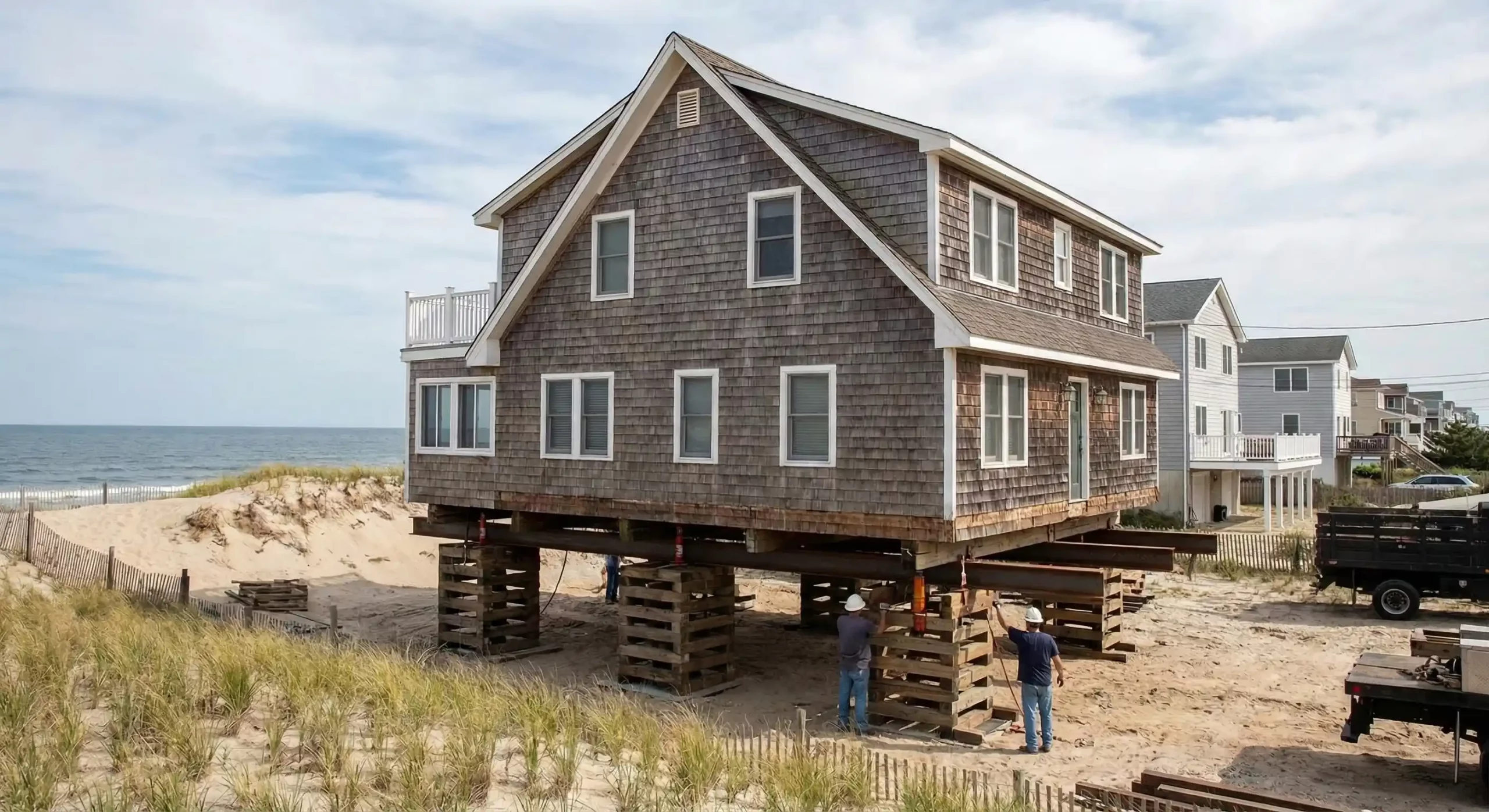
House Raising & Home Lifting in Point Pleasant, NJ
You’re likely searching for House Raising & Home Lifting in Point Pleasant, NJ because the flood maps changed, and your insurance premium just skyrocketed.
If your home was built before the new FEMA maps were drawn after Hurricane Sandy, you are likely sitting below the Base Flood Elevation (BFE). That means every time a Nor’easter hits, you worry about the tide, and every month, you pay a fortune for NFIP flood insurance.
We fix that.
Gambrick Construction is a local Custom Home Builder & General Contractor with over 3 decades of experience at the Jersey Shore. We have successfully lifted dozens of homes since Hurricane Sandy, navigating the complex FEMA codes so you don’t have to.
Lifting the house is only half the job. Unlike simple lifting companies, we provide a full turnkey service. We manage the entire project from utility disconnects and site work to building the new decks and stairs. We hire licensed lifting experts to raise the structure, while we handle the framing, utilities, repairs, finish work, and FEMA-compliant foundations that make your home safe and livable again.
Why Lift Your Shore Home?
Lifting a home at the Jersey Shore is about three things: protecting your property from flood damage, cutting your insurance premiums, and complying with stricter construction codes.
- Slash Insurance Costs (The Freeboard Factor): If your lowest floor is below the Base Flood Elevation (BFE), your premiums are artificially high. We design your lift to include “Freeboard”—an extra 1 to 2 feet of height above the FEMA minimum. This safety cushion satisfies strict town codes and drops your flood insurance rate drastically.
- Beat the “50% Rule”: If your home is declared “Substantially Damaged” (repairs costing more than 50% of the home’s value), the town can force you to elevate it to current code. Raising your home now puts you in control before a storm forces your hand.
- Increase Resale Value: An elevated home is a “storm-ready” asset that buyers in Ocean & Monmouth County pay a premium for.
- Better Views: Lifting the house often clears the dunes or neighbors’ fences, giving you a better, unobstructed view of the ocean or bay.
- Protect Your Structure: By placing your home on a new, stronger foundation reinforced with steel beams & breakaway walls, you keep your living space dry and protect the longevity of the structure.
Will My House Look Weird? (Aesthetics & Curb Appeal)
The biggest fear homeowners have is that lifting their house will ruin its charm. They worry it will look like a “beach shack on stilts” or that the new foundation will look industrial.
This is where being a Custom Home Builder matters. Unlike lifting-only companies, we prioritize architecture and proportion.
- Disguising the Lift: We use stone veneer, brick, or high-quality masonry skirting to cover the new foundation blocks. It makes the home look grounded, not floating.
- Grand Staircases: Instead of flimsy, steep wooden steps, we design wide, welcoming staircases with landings and turn-ins that feel like a grand entrance, not a fire escape.
- Terraced Landscaping: We can design tiered planters or raised garden beds around the base of the home to visually lower the elevation and soften the transition from the ground to the first floor.
Our House Raising Process
Many homeowners worry that lifting a house will crack the drywall or damage the structure. That was a risk in the old days of manual jacks, but technology has changed. We use a Unified Hydraulic Jacking System that lifts the entire home simultaneously, inch by inch, ensuring minimal structural disturbance.
1. Design, Engineering & Permits (Design-Build)
We are a full-service Design-Build firm. That means you don’t need to hire a separate architect or engineer. We handle the architectural plans, structural engineering, and the complex zoning permits required by towns like Point Pleasant and Manasquan. We calculate the required elevation to meet FEMA compliance and maximize your flood insurance savings by securing a compliant Elevation Certificate..
2. Utility Disconnects & Site Prep
Before any steel goes under the house, we manage the utility disconnects. We work with the local gas and electric companies to safely cap off your services. We also handle the excavation required to expose the existing foundation.
3. Steel & Cribbing (The Lift)
We insert heavy-duty steel I-beams through the foundation of your home. The house is then slowly raised and rested on temporary timber supports called “cribbing.”
We Can Lift Any Foundation Type: Whether your home is on a Crawl Space, a Basement, or even a Concrete Slab, we have the engineering expertise to lift it safely.
4. The New Foundation
Depending on your existing foundation and the new flood maps, we will either extend your current masonry or demolish it to install a stronger system.
- For A-Zones: We typically build a split-face block foundation with mandated smart flood vents.
- For V-Zones: We install helical piles or concrete columns with breakaway walls to allow storm surge to pass through safely.
5. Set Down & Turnkey Finish
We lower the home onto its new permanent foundation. Then, as your General Contractor, we handle the finish work. We build your new stairs and decks, make repairs, and reconnect all plumbing and electric lines.
Protecting Your Mechanicals: We also elevate your HVAC condensers, placing them on compliant platforms or mounting them to the structure so they stay high and dry.
If your new layout includes a garage or storage under the house, we finish it completely. We pour the concrete slab, install the garage doors and windows, and handle the insulation, drywall, trim, and paint. We don’t leave you with a shell; we leave you with a finished home.
FEMA Compliant Foundations: Which One Do You Need?
Your flood zone dictates how we build your new foundation. We handle all the engineering to ensure you meet town codes and get the lowest possible insurance rate. To understand the difference between V-Zones, A-Zones, and the LiMWA line, check out our deep dive on FEMA Compliant Building Standards.
If You’re in an A-Zone (Rising Water)
Most homes in Point Pleasant and Brick are in A-Zones. Here, we typically build a Split-Face Block Foundation.
- The Solution: We install FEMA-approved Smart Vents. These allow floodwater to flow through the crawlspace so the pressure doesn’t blow out your walls. This is the most cost-effective compliant foundation. You gain a clean, dry crawlspace or garage for storage.
If You’re in a V-Zone (Waves & Velocity)
In high-risk areas near the ocean or bay, block walls would crumble under wave impact. We must lift the home on an Open Foundation.
- Our Solution: We use Galvanized Steel Helical Piles. These are screwed deep into the earth using compact hydraulic machinery. They’re rock-solid, vibration-free, and won’t damage your home during installation.
- The Look: We build concrete piers and breakaway walls to create storage space that looks like a traditional foundation.
The “Hidden” Risk: Coastal A-Zone (LiMWA)
Warning: Even if your map says “A-Zone,” you might be in the LiMWA (Limit of Moderate Wave Action) line. This requires a V-Zone style foundation. We check this immediately so you aren’t hit with a surprise bill later.
How Much Does it Cost to Raise a House in NJ?
The most common misconception is that the “lifting price” is the total price. You might hear a number like $12,000–$30,000, but that is typically just for the hydraulic equipment to get the house in the air.
A full, turnkey project—including the new foundation, utilities, stairs, and decks typically costs between $50,000 and $150,000+. As your General Contractor, we give you the real number upfront.
Typical Project Ranges (2025 Estimates)
- Simple Projects ($40k – $60k): Small cottage, crawl space to crawl space, minimal elevation.
- Average Projects ($75k – $100k): Standard single-family home, new block foundation, new stairs, and utility connections.
- Complex / V-Zone ($100k – $150k+): Large footprint or waterfront homes requiring deep helical piles and breakaway walls.
Real World Case Study: Our 2025 Point Pleasant Beach Project
To show you exactly where the money goes, here is a breakdown of a Ranch Lift ($187,000 Total) we completed in 2025. This was a “Complete Transformation” including a new garage, stone veneer, and siding.
- The Lift ($32,000): Lifting the home 9 feet.
- The Foundation ($44,000): New slab and block foundation for a 2-car garage.
- Turnkey Finish Work: Drywall, electric, and stairs for the new garage.
- Exterior & Site: New Stone Veneer, full siding, new driveway, and HVAC elevation.
The Takeaway: The “Lift” was only 17% of the budget. The rest was spent on making the home beautiful and functional.
Financial Help & ROI
The math often works in your favor. If your home is “Substantially Damaged,” you may be eligible for the $30,000 ICC Grant or the HMGP Grant (up to 75% coverage). Plus, elevating to compliance can cut your flood insurance by 30-60% and significantly boost your resale value.
Frequently Asked Questions
Can I live in the house while it’s being lifted?
No. For safety reasons and because utilities (water, sewer, gas, electric) must be disconnected, the home must be vacant during the lift and foundation construction. typically, you can move back in once the house is set down and utilities are reconnected, even if we are still finishing decks or siding.
How long does the project take?
Once we break ground, the construction phase typically takes 3 to 6 months. However, the “paperwork phase” (Architecture, Engineering, and Town Permits) can take 2-4 months before that.
Will lifting the house crack my drywall?
With the Unified Hydraulic Jacking System, the lift is incredibly smooth and synchronized. While minor cosmetic hairline cracks in drywall are possible, structural damage is extremely rare. As your General Contractor, we repair any cosmetic imperfections during the finish phase.
Do you handle the permits?
Yes. We handle all zoning, building, and flood certificates required by towns like Point Pleasant, Brick, and Manasquan. The permitting process can be complex and frustrating; we handle the bureaucracy so you don’t have to.
My house is on a concrete slab. Can it still be lifted?
Yes. Lifting a house off a slab requires a specific engineering process to separate the walls from the slab. We then insert steel beams through the house instead of underneath it.
Service Areas
Gambrick Construction is proudly based in Point Pleasant, NJ. Our core service area focuses on the coastal communities of Monmouth and Ocean County.
- Point Pleasant Beach & Borough
- Bay Head & Mantoloking
- Manasquan & Brielle
- Spring Lake & Sea Girt
- Brick Township & Toms River
- Wall Township & Howell
- Lavallette & Ortley Beach
- Rumson & Colts Neck
- Princeton (Select Projects)
Statewide Projects: While our daily operations are concentrated along the Jersey Shore, we accept select large-scale projects throughout New Jersey, including Bergen, Essex, and Mercer Counties.
Ready to Get Started? Let’s talk about how we can help.
Call 732-892-1386 or contact us online today.