
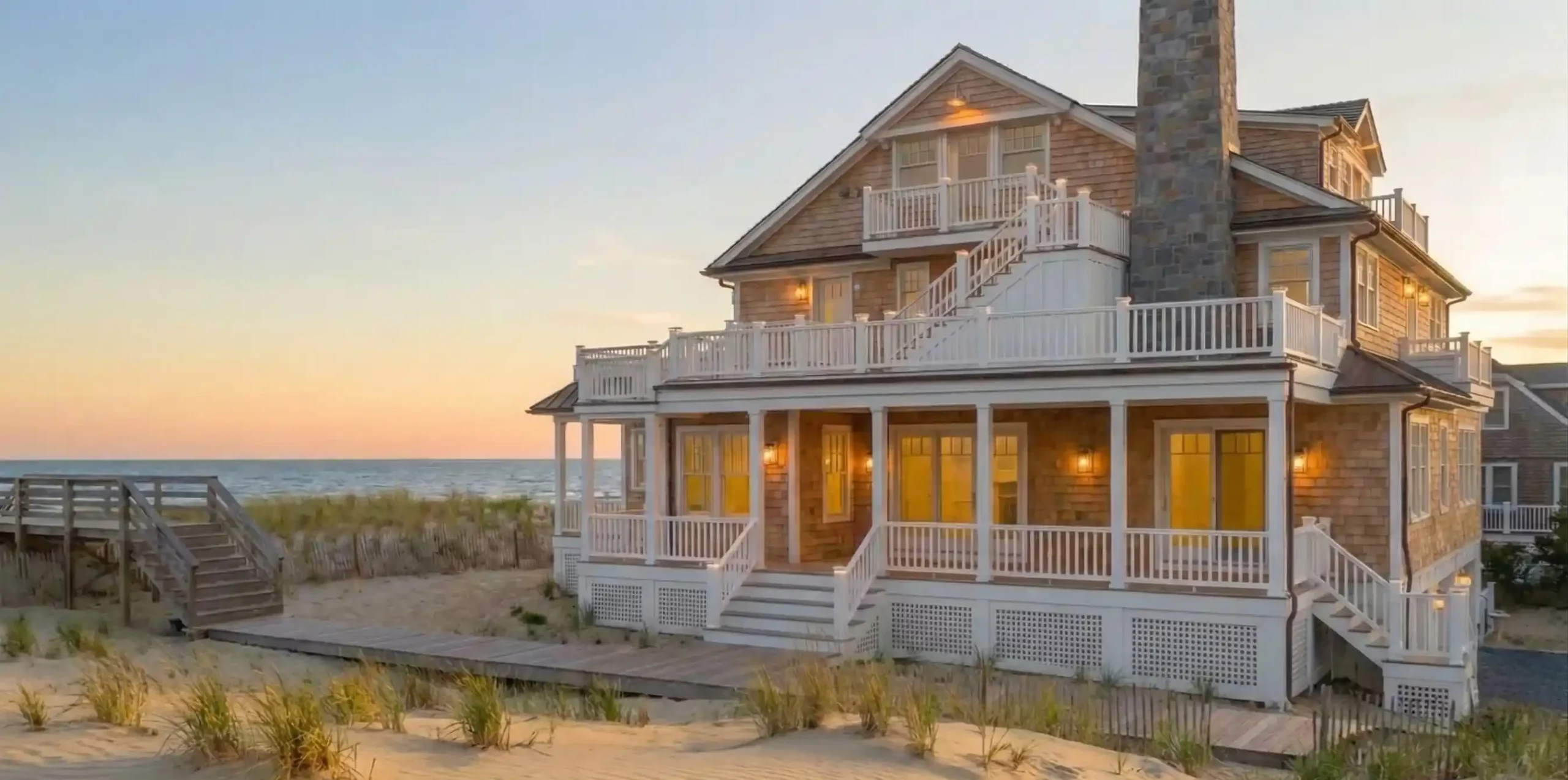
FEMA Compliant Builder & Flood Zone Construction in NJ
You need a FEMA Compliant Builder because building a house at the Jersey Shore isn’t like building inland. The wind is stronger, the salt eats everything, storm surge flooding is a major problem, and the FEMA Flood Maps keep changing. If you own a home in Point Pleasant Beach, Bay Head, or Mantoloking, you probably worry about two things: the next big storm and your expensive flood insurance bill.
For over 3 decades, Gambrick Construction has built “storm-proof” new homes, additions, and ADUs right here at the Jersey Shore.
You need a team that knows the local codes in Ocean County and Monmouth County. We handle the hard stuff—like installing spread footings & helical piles in sandy soil, designing breakaway walls for V-Zones, and managing the paperwork for the town’s 50% Rule.
What Does “FEMA Compliant” Actually Mean?
FEMA Compliant means we build your house high enough and strong enough so the ocean goes under it, not inside it.
At the Jersey Shore, “Compliance” isn’t just about avoiding a fine from the town. It’s the difference between a house that survives a hurricane and one that gets destroyed. Here are the three main compliance rules that affect your wallet.
1. The “Magic Number” (BFE + Freeboard)
Every property has a Base Flood Elevation (BFE). This is the height FEMA thinks floodwaters could reach during a 100-year storm. If the map says your BFE is 9 feet, your first floor must be at least 9 feet high.
We usually build 1 to 3 feet higher than required. This is called “Freeboard.” Lifting your house an extra foot can drop your National Flood Insurance Program (NFIP) premiums. We handle the Elevation Certificate (EC) to prove your compliance to the bank.
2. The “50% Substantial Improvement Rule”
If you want to renovate an older home in Ocean or Monmouth County, and the cost of the renovation is more than 50% of the structure’s market value, the town can force you to bring the entire house up to current FEMA codes, including lifting it.
We know exactly how to navigate the specific submission requirements for all local building departments—especially in strict towns like Brick, Point Pleasant Beach, and Mantoloking.
3. Elevating Your Utilities
It’s not just the floor that needs to go up. Your HVAC units, water heaters, and electrical panels must also be raised above the BFE. We build custom utility platforms that keep your expensive mechanical systems safe from saltwater corrosion and flooding.
Know Your Zone: V-Zone vs. A-Zone Construction
Most homeowners in Ocean & Monmouth County don’t know the difference between an A-Zone and a V-Zone until they see the price of their foundation. The letter on your flood map changes everything about how we build your house.
1. V-Zone (Velocity Zone)
Think “Violence.” The “V” stands for Velocity. These zones are usually right on the oceanfront in Mantoloking or the open bayfront along Barnegat Bay and the Manasquan River. In a V-Zone, 3-foot waves can crash into your house.
- Below Ground: We don’t use a shallow footing here because the sand will wash away (scour). We drive timber piles or helical piles deep into the earth. These anchor your home so it doesn’t float away.
- Above Ground: You cannot have solid concrete foundation walls because they act like a dam. The house must sit up on “stilts” (columns) so water can flow freely underneath.
- Breakaway Walls: We enclose the open space between columns to create an enclosed garage or storage area using Breakaway Walls. These look like normal walls but are designed to detach safely when waves hit them, so they don’t pull the house down.
2. A-Zone (Coastal A & Standard A)
Think “Rising Bathtub.” In an A-Zone (common in Brick Township and back-bay Point Pleasant), water usually rises up gently rather than crashing in. FEMA wants the water to flow through your foundation to equalize the pressure.
- Smart Vents: We use a continuous concrete foundation (cinder blocks or poured walls) with Smart Vents (Flood Vents). These engineered stainless steel vents automatically unlock when floodwater hits them, letting water flow into the foundation so your walls don’t blow out from the pressure.
3. The “Hidden” Zone: Coastal A (LiMWA)
There is a tricky zone called the “Coastal A-Zone,” marked by the LiMWA line (Limit of Moderate Wave Action). You might legally be in an A-Zone, but because you’re close to the V-Zone, FEMA recommends building to V-Zone standards. We check this line on every project to ensure you aren’t building a home that’s expensive to insure.
Our Coastal Engineering Solutions
We don’t rely on luck to keep your house standing during a hurricane. We rely on physics and high-quality materials. Over the last 30 years, we have refined exactly which products survive the salt and wind in Ocean County and which ones fail.
1. Deep Timber Piles (The Standard for New Homes)
For most new construction & additions in V-Zones, we use traditional pressure-treated timber piles. These are driven deep into the sand until they hit significant resistance.
They’re incredibly strong, cost-effective, and provide the deep friction required to hold your home steady against scouring waves.
2. Helical Piles (The Solution for House Lifting)
When we’re lifting an existing house, we can’t fit a massive timber pile driver underneath it. That’s where Helical Piles save the day.
Helical piles are like a giant galvanized steel screw. We use compact hydraulic machinery to twist them into the ground. They’re the perfect solution for house raising projects where access is tight, but structural strength is critical.
3. The “Storm-Proof” Envelope
Keeping the water out is just as important as holding the house up.
- Impact-Rated Windows: We install top-tier coastal series windows from Andersen and Marvin. These have reinforced glass that can take a hit from flying debris without shattering.
- Wind-Rated Roofing: We use architectural-grade asphalt shingles or standing seam metal roofing that can withstand wind gusts over 110+ mph.
- Fiber Cement Siding: Vinyl siding often cracks or blows off in high wind. We prefer James Hardie Fiber Cement. It’s heavy, durable, and immune to the salt air rot so common at the Jersey Shore.
4. Steel & Strapping
A strong frame is one of the most important parts of the house.
- Continuous Load Path: We use Simpson Strong-Tie hurricane straps and anchor bolts to tie the entire house together, from the roof rafters down to the foundation. This creates one solid unit rather than a stack of separate parts.
- Steel Moment Frames: If you want massive walls of glass to see the ocean, standard wood framing isn’t strong enough. We bolt structural steel frames into the house to keep it rigid while giving you the open, modern views you desire.
Our Process: How We Get You From “Flood Zone” to “Safe Home”
Navigating FEMA rules and town permits is complex. One wrong measurement on a site plan can delay your project for months. Here is how we manage the process so you don’t have to.
Step 1: The Feasibility Study
Before we draw a single line, we verify exactly what you can build. We analyze your lot’s specific FEMA Flood Map, check the zoning setbacks, and review the soil conditions to see if you need deep pilings or standard footings.
Step 2: Engineering & Design
We design your floor plan to maximize views while hiding the structural pilings. We coordinate the Structural Engineering and Plot Plans required for the permit application, ensuring every inch of the home meets the 50% Rule and V-Zone standards.
Step 3: Permitting
We submit your plans to the township and handle all the back-and-forth with the Zoning Officer. If you need a CAFRA permit from the NJ DEP, we manage that application too.
Step 4: Construction & Elevation Certificate
We build your home or addition. Once the foundation is set and the framing is done, we coordinate the final Elevation Certificate. This is the document you give to your insurance agent to prove your home is compliant and get the lowest possible rate.
Frequently Asked Questions on Flood Zone Building
I have an old bungalow in Point Pleasant. Is it cheaper to lift it or knock it down?
Lifting is cheaper upfront, but rebuilding is often the better investment. When you lift an old house, you still have an old house, with old wiring, old plumbing, and drafty walls. A Knockdown & Rebuild costs more initially, but it gives you a brand new, energy-efficient asset that’s worth significantly more money.
Is there any financial help available to lift my house?
Yes. If your home was damaged by a storm and you have flood insurance, you may be eligible for up to $30,000 in Increased Cost of Compliance (ICC) coverage. This is a specific part of your policy designed to help pay for elevating a “substantially damaged” home. We can help you navigate this paperwork.
How high do I actually have to build?
FEMA sets a minimum, but New Jersey is stricter. The state requires new construction to be at least 1 foot above the FEMA Base Flood Elevation (BFE). We recommend going even higher (2 to 3 feet) to protect against future sea-level rise and to secure the lowest possible flood insurance rate.
Can I finish the ground floor in a V-Zone?
No. In a V-Zone, the area below the BFE must remain free of obstructions. You can use it for parking, storage, and building access, but never for finished living space. If you do, the town will make you tear it out, and your insurance may be voided.
Service Areas
Gambrick Construction is based in Point Pleasant, NJ. Our core service area covers the coastal communities of Ocean and Monmouth County.
- Point Pleasant Beach & Borough: home base, on-site daily
- Bay Head & Mantoloking: barrier island builds, V-Zone and CAFRA specialists
- Manasquan & Brielle: Manasquan River waterfront and coastal custom builds
- Spring Lake & Sea Girt: luxury custom homes and high-end coastal renovations
- Brick Township & Toms River: new construction, knockdown rebuilds, and house raising
- Lavallette & Ortley Beach: barrier island new builds and FEMA elevation projects
- Wall Township & Howell: custom homes and additions inland of the Shore
- Rumson & Colts Neck: luxury estate builds in Monmouth County
- Princeton: select large-scale custom home projects
Statewide: We accept select large-scale custom home projects throughout New Jersey, including Bergen, Essex, and Mercer Counties, on a case-by-case basis.
Ready to talk about your project? Call 732-892-1386 or contact us online. We offer free consultations and give you a straight answer on what your lot can support before any design work begins.